
The process of progress
What we can learn from The Structure of Scientific Revolutions by Thomas Kuhn

The Structure of Scientific Revolutions by Thomas Kuhn analyses the process of scientific progress. Not gonna lie, this one was a challenging read, mainly because it felt like I was having to search the definition of every second or third word before I could even begin to grasp the overarching concepts.
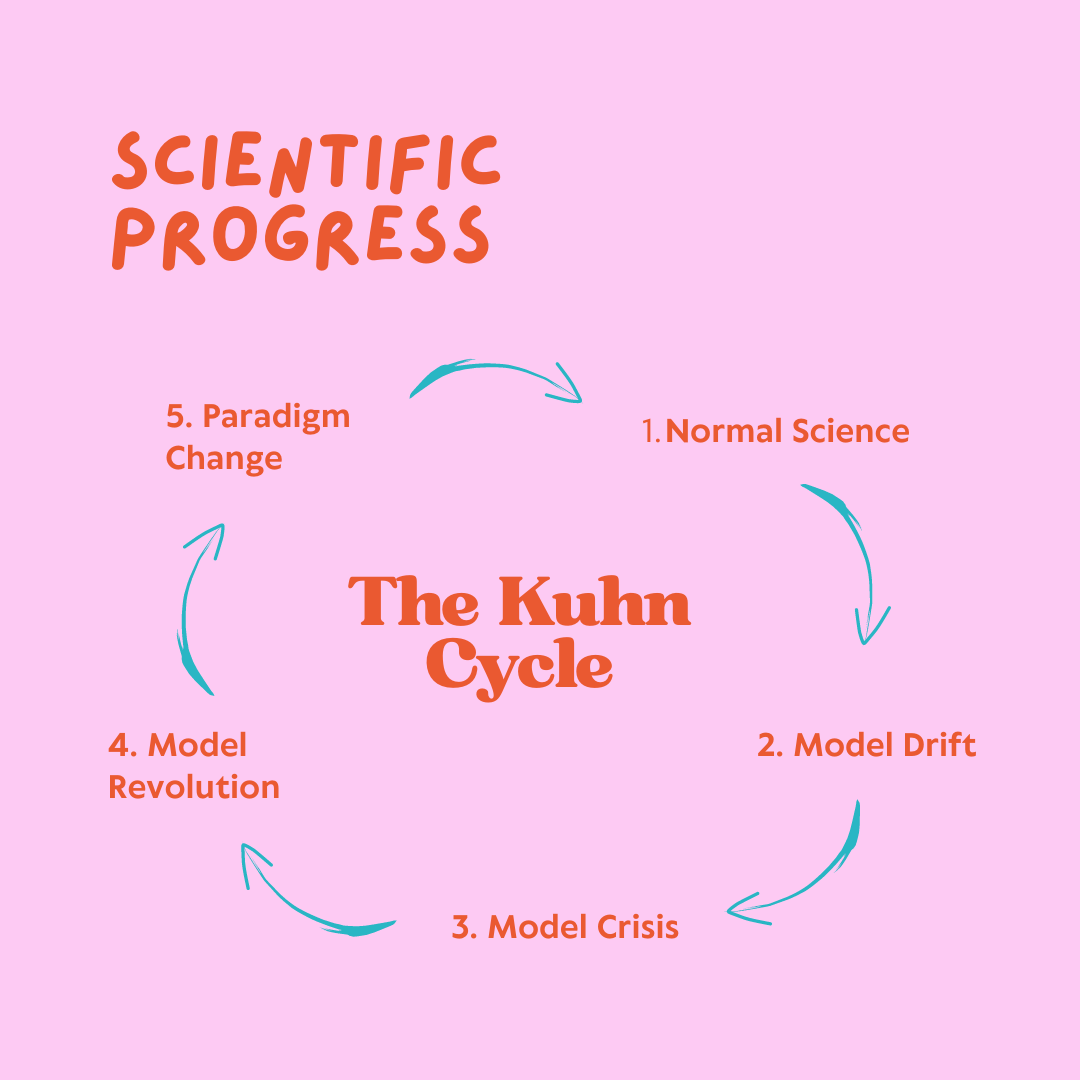
The following provides a high level summary of the Kuhn Cycle:
Normal Science - day-to-day work of scientists researching, observing and experimenting within a settled paradigm.
Model drift - emerging research findings start to conflict with previous expectations.
Model crisis - established theories and models are found to be incompatible with evidence from new discoveries.
Model revolution - the field begins to undergo revolutionary change. One or more competing models emerge to resolve issues with the previous model.
Paradigm change - one of the newly proposed models becomes generally accepted as being correct.
While understanding the process of scientific progress may not sound all that exciting for many of us, a lot of the thinking actually provides some great insight for informing us on how to make progress in all areas of life, whether it be in our education, careers, relationships, and even in our pursuit of happiness.
In terms of personal development, the Kuhn cycle might look something like this:
Normal every-day life; your existing routines, values and beliefs.
Model drift - something feels off. You stop enjoying your career, your investment strategy isn’t working or your relationship doesn’t have the same spark.
Model crisis - something challenges your views and beliefs. You start to question your own thinking and seek out ways to gain clarity.
Model revolution - You have the Aha moment where it all falls into place.
Paradigm change - you look at the world in a new way based on your newly found knowledge and experiences.
Paradigms are a key ingredient for progress.
Kuhn discusses the importance of paradigms for making scientific progress on many occasions. But what is a paradigm?
Paradigms are often just a way of looking at things; a pattern or a model. One definition of paradigm provided by Kuhn in the Science of Revolutions is:
“Accepted examples of scientific practice, including laws, theories, applications, experiment, and instrumentation, provide the models that create a coherent tradition and serve as the commitments which constitute a scientific community in the first place.”
But this doesn’t only apply to science. As individuals within a society, we all have paradigms for politics, fashion, careers, the people we look up to, and so on.
Unlike with science however, our own personal paradigms often tend to be formed unconsciously. We may have paradigms for the way we invest our money, the people we form relationships with, or for what makes us happy.
Therefore, to make progress in these areas, it is critical for us to understand the rules we have developed for our own personal paradigms. What are the boxes a company needs to tick before you invest in their shares? What values do you need to have in common with your partner for you both to click? What does true happiness look like to you?
While it doesn’t seem like much, putting together the rule book for your personal paradigms is a key step towards making progress in your own life.
Don’t shy away from a crisis.
Paradigms need to be first established before any contradictions to the paradigm can be discovered. Kuhn discusses that for scientific revolutions to occur, a “crisis” point typically needs to be encountered, which refers to the stage at which original theories, experiments and practices are found to be incompatible with emerging discoveries.
As with paradigms in science, your own personal paradigms will likely at times become conflicted and reach a crisis point. You may lose the majority of your wealth in the stock market, become unhappy in your relationship, or find that the opinions you hold are causing pain to yourself and/or others around you.
Be open minded. Take the learnings wherever you can and keep moving forward.
There’s a quote taken from Max Planck’s Scientific Autobiography inside The Structure of Scientific revolutions;
“A new scientific truth does not triumph by convincing its opponents and making them see the light, but rather because its opponents eventually die, and a new generation grows up that is familiar with it.”
While scientific truth may be able to wait on the deniers to die before progress to be made, your personal progress stops with you and only you. Don’t deny yourself progress by shying away from a crisis and refusing to accept change.
Progress is a process of moving away, not moving towards.
When discussing the evolution of scientific progress, Kuhn asked;
“Does it really help to imagine that there is some one full, objective, true account of nature and that the proper measure of scientific achievement is the extent to which it brings us closer to that ultimate goal?”
He also proceeded to say later in the book;
“For many men the abolition of that teleological kind of evolution was the most significant and least palatable of Darwin’s suggestions. The Origin of Species recognized no goal set either by God or nature.”
The argument for science being a process of moving away is key to understanding how progress is made because it helps us to focus on disproving what we think we know, rather than trying to continuously attack problems using the same broken tools or assumptions with the hope of achieving a better result.
When progress is viewed as a process of moving towards, you make the assumption that you are already on the right path, heading in the right direction towards the right place - when in reality, you may be heading in the complete opposite direction to a destination that doesn’t even exist.
That’s not to say there’s anything wrong with setting goals for what you want to achieve in life. in fact, goals are an incredibly powerful tool for providing ourselves with purpose, for holding ourselves accountable to promises we have made and for enabling ourselves to measure progress. For example; by setting yourself the goal to make yourself $1M profit on investments within the next 3 years, any decisions you make around managing money will be rigorously assessed against its ability to bring you closer to this goal, likely drastically improving your chances of success.
Instead, what Kuhn tells us when saying that progress is a process of moving away is that it’s better to be constantly looking for ways to question and disprove your thinking, to embrace change with open arms and be prepared to adapt. Set goals, but don’t look at your goals as being your final destination.
So many “successful” people on this planet become severely depressed when achieving their goals failed to provide them the happiness they had sought. Every year we hear the tragic news of another celebrity passing; Kurt Cobain, Jimi Hendrix, Mac Miller, giving rise to the infamously named “27 club”.
By perceiving our goals as the final destination, we risk becoming trapped by our own success, leading us to feel hopeless and like there’s nowhere to go once we achieve these goals.
Be willing to accept that you might have made a wrong turn at some point along the journey. Hell, you may have even set out in the wrong direction as soon as you turned down the street. But don’t look at this like it’s a bad thing; pull over and assess the situation, then realise that this is an incredible opportunity for you to make real progress.
Thanks for reading! Feel free to subscribe for a fortnightly delivery of tips and tricks for starting a group investment fund, along with a bunch of extra great educational resources and summaries on different investments that Crate Holdings Partners are looking at.
About us
Here at Crate Holdings Partners, we’re just a group of mates trying our hand at investing by pooling together a small amount of our hard earned wages each week.
We started Mates Rates Capital as a project to share our tips, tricks, mistakes, and learnings so that you can go start a group investment fund and reap the rewards of investing with friends.
Come along for the ride! 🤙